Blog
Studien, Produkt-Updates und praktische Anleitungen dazu, wie Marken Erwähnungen und Zitate in ChatGPT, Claude, Gemini, Perplexity und Google AI Overviews erzielen.
Run a simple no-code GEO audit for your app by querying answer engines with unbranded category searches and auditing crawler access, content accuracy, authority metrics, and media integration. Testing real search data rather than branded queries reveals whether AI engines accurately cite your domain.
Identifying which pages are cited in AI answer engines requires automated prompt monitoring to extract hyperlinked URL payloads from engine responses. Standard web analytics like Google Analytics 4 miss zero-click citations when engines answer queries using cached snapshots.
To optimize product launch press releases for LLM citation retrieval, companies should host technical announcements on their own domains and structure facts as explicit entity-attribute-value pairs. In Vizzybl tests, company newsroom pages earned more than double the citations of wire services.
Winning market share in AI engine recommendations over competitors requires auditing third-party citations, tracking mentions on non-branded prompts, and structuring data in native HTML tables. Success relies on optimizing for the external sources each engine queries rather than owned content alone.
Solo founders should monitor AI search prompts through automated daily data collection, but evaluate performance metrics across a rolling seven-day window. This schedule tracks rapid citation volatility without causing reactive site updates based on daily algorithmic noise.
Monitoring if LLMs mention competitors instead of your vibe coding app requires running systematic prompt sampling and parsing cited domains across generative engines. Converting real search console queries into conversational prompts provides an accurate baseline to audit competitor citations.
AI visibility platforms can track the exact citation sources that feed competitor recommendations in AI answer engines by resolving links to specific URLs. They categorize whether sources stem from owned domains, third-party publishers, or user-generated content across generative engines.
To optimize informational content to win AI Overview citations, increase fact density per paragraph, organize text with semantic HTML tags, and answer query intents directly at the start of every section. Blog and news-style formats win substantially more citations than standard documentation pages.
To fix wrong product pricing in ChatGPT, update underlying citation sources, add JSON-LD Product schema markup to canonical pages, and monitor prompt outputs daily. Because OpenAI lacks manual support for edits, corrections must occur through structured web data and continuous visibility tracking.
Tracking brand mentions in AI search requires using an AI visibility platform to audit full conversational prompts, evaluate mention rates, and analyze cited URLs across generative engines. Monitoring prompts where a brand already ranks in traditional search provides reliable baseline metrics.
Tracking ChatGPT and Perplexity referral traffic in GA4 requires custom channel groups matching both HTTP referrer headers and platform UTM parameters. GA4 cannot track underlying user prompts, but custom channel definitions isolate AI sessions, conversion metrics, and CRM lead attribution.
AI search prompt research identifies and tracks the multi-layered conversational prompts buyers submit to engines like ChatGPT and Perplexity. Content teams use taxonomies, query fan-out mapping, and clustering to track brand citations across LLMs.
Choosing between Profound and Peec AI depends on operational goals: Profound provides deep diagnostic intelligence into citation shifts, while Peec AI offers simplified brand recommendation reporting. Both platforms track visibility across major engines like ChatGPT, Gemini, and Google AI Overviews.
Prioritizing off-page review sites versus owned blog content in a GEO strategy depends on query intent. Commercial queries heavily favor third-party review platforms, while informational queries pull from structured blog articles and documentation.
Google AI Overviews cites blog, insights, and news pages far more often than technical product documentation for commercial buyer queries. Technical documentation is cited almost exclusively for granular procedural prompts and execution tasks.
Recovering organic click-through rate lost to AI summaries requires increasing nugget density, publishing original statistics, and implementing structured data. Restructuring pages with immediate answer placement and high information gain helps earn AI engine citations while compelling users to click.
Google Search Console query data provides the foundation for AI prompt research by revealing topics where a site already has search authority. Applying regex filters isolates natural language questions, which must be restructured with buyer context to track brand visibility across AI engines.
Marketing teams should run prompt monitoring tests daily across major LLMs rather than weekly or monthly to capture rapid citation churn. Evaluating daily data over multi-day rolling averages separates actual visibility shifts from standard AI output randomness.
AI search visibility tracking measures, monitors, and analyzes how generative AI engines mention, quote, and cite brands in synthesized answers. The process evaluates brand mention rates, citation share, and contextual sentiment across platforms like ChatGPT.
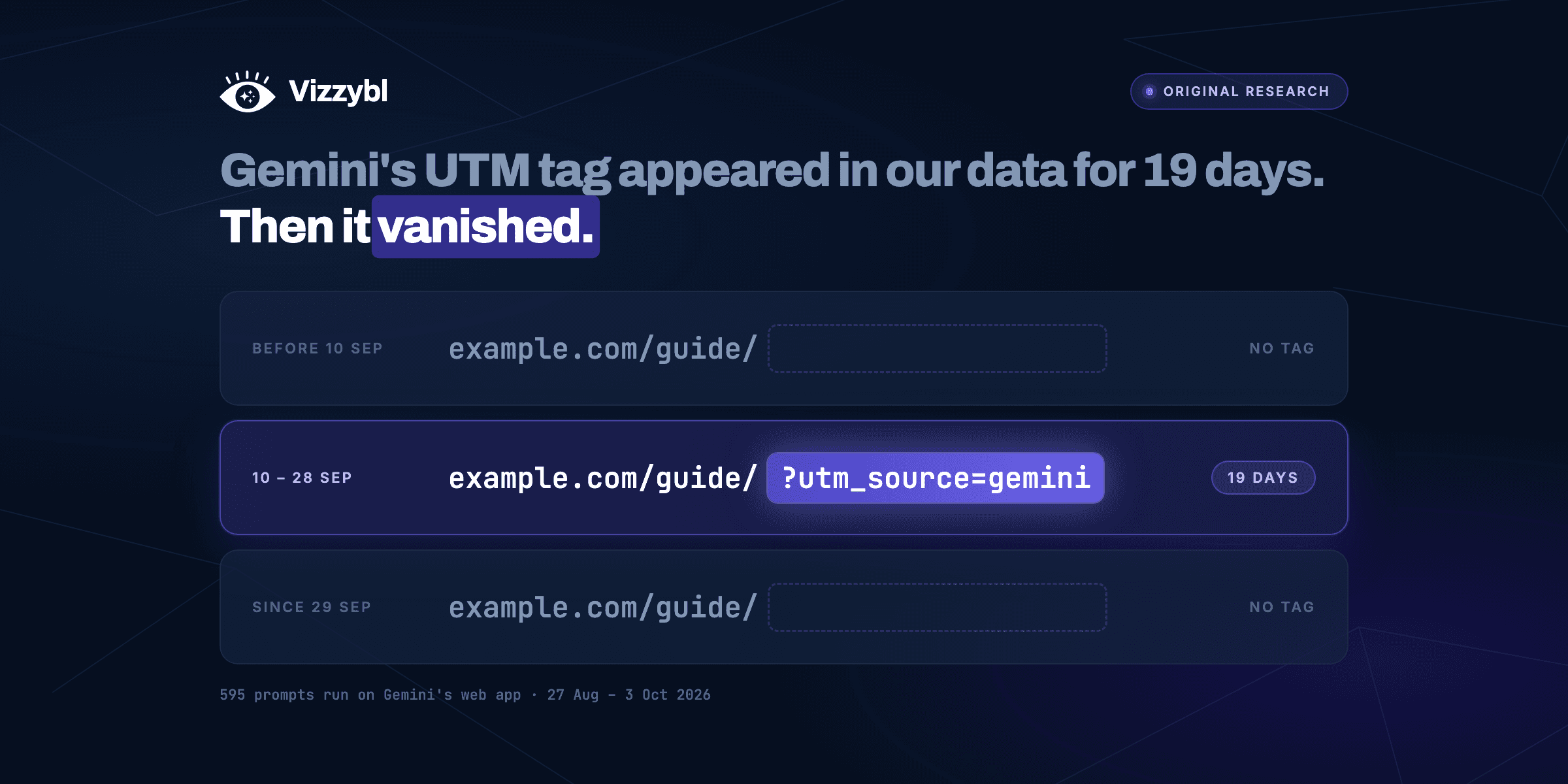
Gemini UTMs are here. It means you can now attribute traffic coming from Gemini. At Vizzybl we can provide you with more than just the UTM tags. That is useful, but the most valuable data is the text anchor. That won't appear in your logs or in GA4 but we can identify the text on the page. Giving you insights on what content of yours or your competitors is being used.
Vizzybl has officially launched in partnership with Google Cloud’s Global Founder Advocates program. Discover how our AI agentic platform helps enterprise brands master Answer Engine Optimization (AEO) and protect their visibility across AI search models.
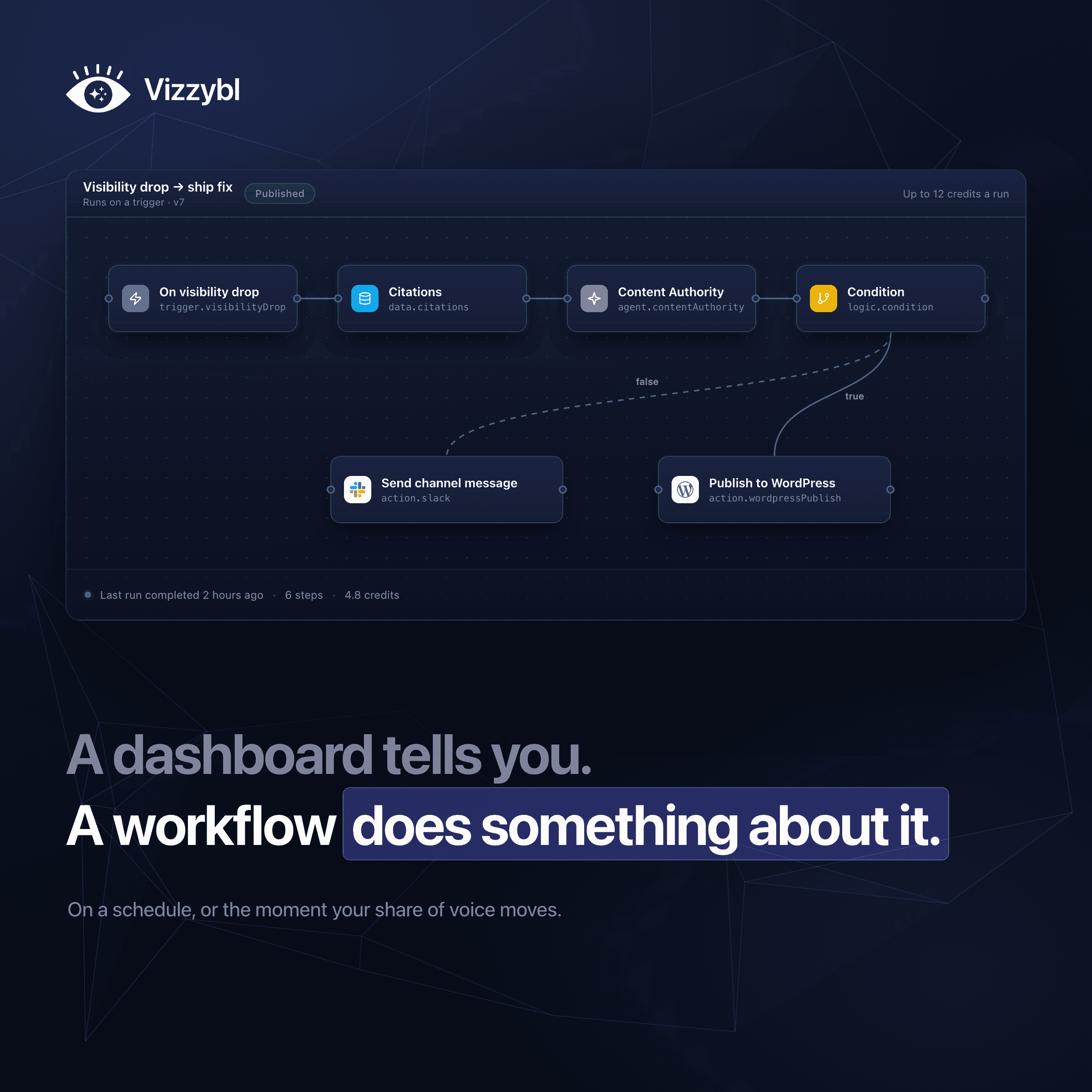
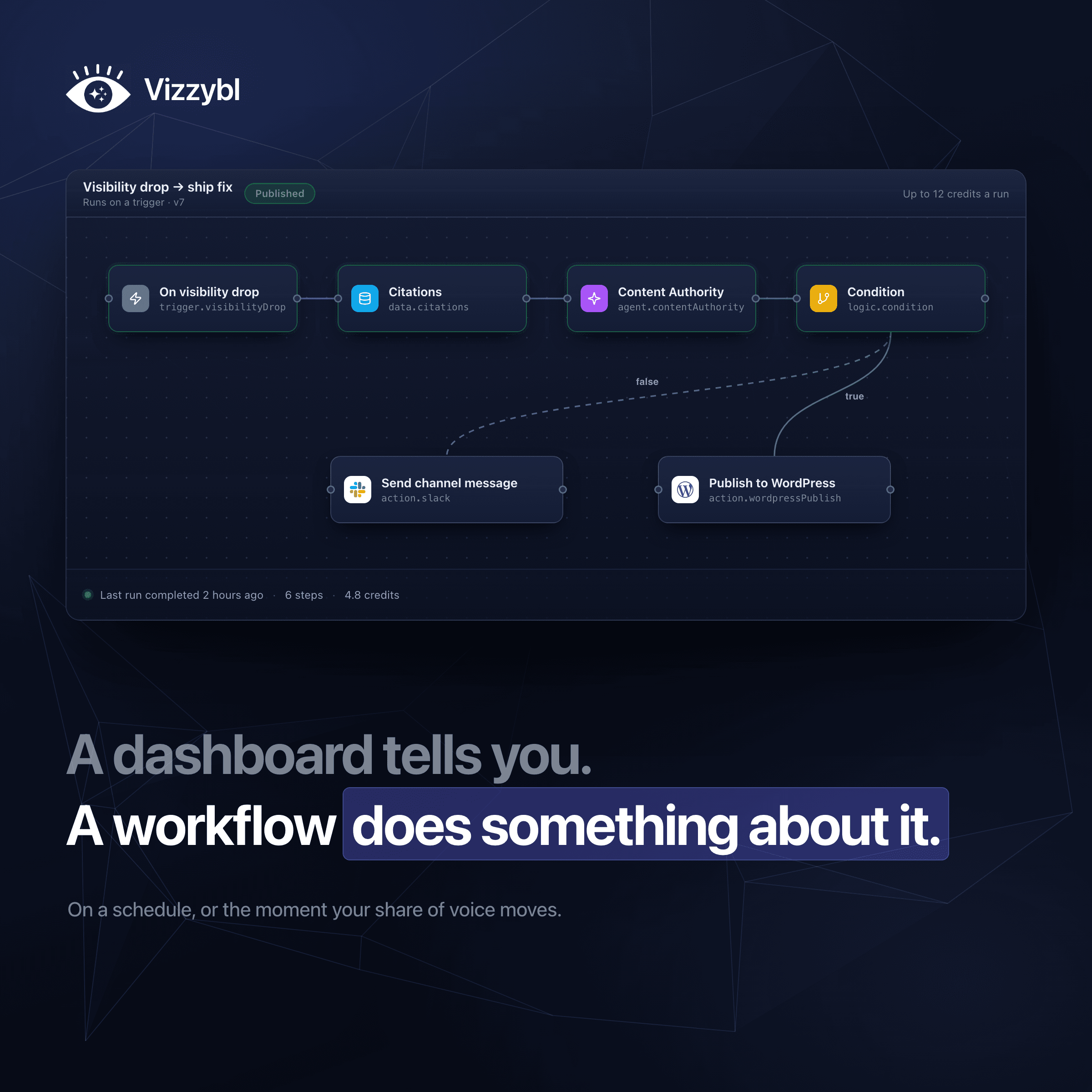
Dashboards tell you what's wrong with your AI visibility. Workflows fix it, and keep fixing it on a schedule or the moment something changes.
Introducing our Claude Skill that enables you to use your Vizzybl GEO & AEO data with the power of Claude.